


.png)
Menopause Ski Boots: Why Your Feet Change and What to Do About It

The boots haven’t changed - but your feet, tolerance and sensory feedback might have.
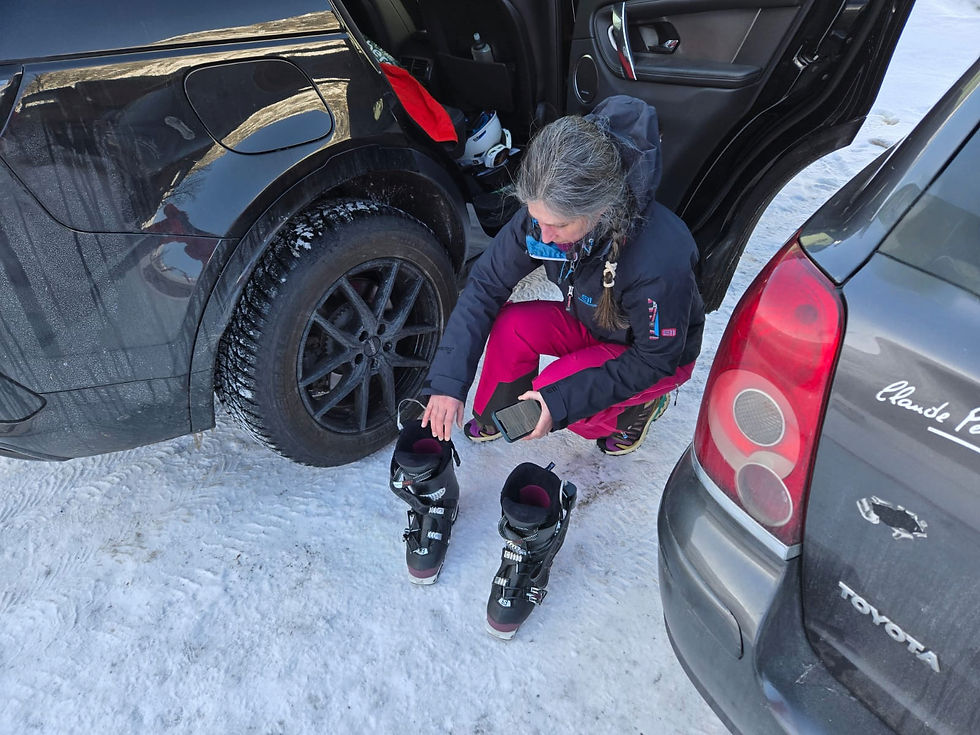
I used to be someone who could put ski boots on and forget about my feet.
Now, there's a ritual.
The night before skiing, I lay everything out – checking batteries are charged, looking at the forecast, deciding what kind of skiing makes sense tomorrow. In January, when I spend the most time on snow, there's often a lot of battery-charged kit lined up.
It's adaptation.
Because menopause changes how feet tolerate cold and pressure. After fifty weeks in trainers, ski boots are about as unforgiving as footwear gets.
What Oestrogen Has to Do With Menopause Ski Boot Fit
During menopause, oestrogen decline affects how feet function in ways that matter enormously in ski boots.
The heel fat pad – the natural cushioning under the foot – can thin.
The feedback loop between feet and brain – the sensors that tell you where you are and how much pressure you're under – can become less efficient.
Blood flow to your feet and lower legs can change, making them feel colder.
The speed at which nerves send signals can slow down, so sensation becomes less reliable. The collagen that gives tendons and ligaments their strength and flexibility can weaken, making feet less resilient under load.
In a rigid, cold ski boot, those changes don’t just show up - they’re exposed.
Pressure points that never used to exist. Cold feet that never really warm up. A sense that something feels different - even though your skiing hasn’t changed.
In a rigid, cold ski boot, those changes don't just show up – they're exposed brutally.
Why I understand this first-hand
I've had surgery on my right big toe joint to restore movement after arthritis. The alternative would have been fusing the joint – less pain, but also less movement. I chose mobility.
I also have altered sensation in my left foot following nerve compression in my lower back. That means less reliable feedback and more sensitivity to pressure and cold.
Add menopause to that baseline, and the margins get smaller again.
So when I talk about menopausal foot changes on top of existing foot issues, I'm not speaking theoretically. I'm describing what happens when your body keeps changing – and understanding what's happening can be such a flippin relief.
What can I do if my ski boots hurt?
Good boot fitting isn't one thing. It's layered. You don't need to go full custom immediately – you can start simple and build as your needs change.
Level 1: Custom footbeds - These support the actual shape of your foot, not a generic model. They redistribute pressure, improve alignment, form the foundation of comfort. If you own your boots, start here.
Level 2: Heat-mouldable liners - Most modern liners can be heated and shaped to your foot. Some continue to adapt over time. You might get a few remoulds as your feet change.
Level 3: Shell work - The plastic shell itself can be heated and punched out in specific areas, or ground from the inside to relieve pressure points. Precise, targeted work – creating space exactly where you need it.
Level 4: Heating systems - Systems like Therm-ic or Sidas add warmth without bulk. They don't change the boot – they reduce one of the biggest stressors your nervous system has to manage.
I'm all the way at Level 4 now – heated footbeds, moulded liners, the lot!
This isn't about luxury. It's compensation for physical change.
Heating helps. Customisation helps. But none of it is a cure. It's management.

When you know it's time to adapt again
Recently, my shins started hurting. Not just while skiing. All the time.
That's the signal. Time for a remould....or maybe even new boots as mine have done a fair bit of mileage.
After back surgery and rehab, my feet changed shape again. Years of guarding from pain had shortened them until recovery altered them again.
The boots that worked last season don't always work this one. Not because anything went wrong – but because I changed.
Feet change through menopause.
The heel fat pad thins.
Circulation shifts.
If your boots felt fine last year and hurt now, there may be some real physiological changes to consider around why that might be. Give yourself permission to have comfort in ski boots whether thats the fit of them or the warmth they provide; whatever you need.
The boot should accomodate what the body needs; what your feet need, not the other way round.
It's not just ski boots
This doesn't stop at skiing.
Indoor bouldering in January? Some people are still in vests. Cleary a different physiology at play.
I know quite a few of the women my age: woolly hats, gilets for manoeuvrability, hand warmers tucked into pockets – which is a balancing act, because chalk doesn't love warm hands.
Climbing shoes? The thinnest socks I can manage. Two hours max. Massage between boulder problems.
Outdoor climbing in the Peak District in winter? No thanks.
Cycling: heated socks, over-booties.
Dance class in an old church hall with minimal heating? Everyone else is in socks and salsa sandals. I'm eyeing up leggings.
The pattern is unmistakable: constantly cold feet. Hot flushes. Hands that sweat when they need grip (in climbing at at least!). Altered temperature regulation and sensations – playing out across a myriad of sports and activities.
Walking barefoot even hurts now. The cushioning under my feet has genuinely changed.
I live in absurdly cushioned trainers. I do foot and toe work through Pilates, Nordic walking, and classic cross-country skiing. Not to "fix" my feet. To maintain what I still have.

When comfort becomes performance
My husband is an amazing skier (what else can I say?!). When I asked him what he looks for in a ski boot, he had two words: "Stiff Flex."
Performance. Precision. Responsiveness.
He orders the same boots every time – same size, online. They arrive. They fit. Same with trainers, hiking boots, everything. His needs haven't shifted much over the years.
Mine have.
I'm also BASI-qualified. I used to own race-fit boots. Performance-oriented. Tight. Responsive.
Recently, a friend and I found ourselves trying on ski boots with furry liners and laughing at ourselves but there's a very real reason we're drawn to fluffy boot linings as they clearly signal comfort and warmth. Why wouldn't we want that?
But here's the thing: women's boots from major brands are marketed as "women's boots" – one category for all life stages.
Puberty. Menstruation. Pregnancy. Perimenopause. Menopause. Post-menopause.
One boot category for bodies that go through multiple fundamental transitions.
That's not about gender. It's about life stage.
The race-fit boots I wore in my late 30s? I was in agony in them by my mid-40s despite expert fitting at one of London's best boot fitters. Not their fault – they work with what the boots are, the insoles, the moulding, the customisation.
Did they understand neuropathy? Not really. Could they address what oestrogen decline does to soft tissue tolerance? No. That's not in the fitting model.
Performance used to mean: responsive, precise, powerful.
Now it means: adaptive, comfortable, sustainable.
Puberty. Menstruation. Pregnancy. Perimenopause. Menopause. Post-menopause. One boot category for bodies that go through multiple fundamental transitions.
Making rental boots work for you
If you're renting, don't let yourself be part of the sausage factory.
Rental shops can feel like conveyor belts – especially on arrival day. You're tired, you want to get in and out and there's usually a queue behind you.
Try the boots on. Walk around. Then flex properly – at your ankles and knees as if you're skiing. When you do this, your heel locks back and your toes pull away from the front. That's why boots can feel tight standing still but different when you're actually skiing.
The boot should feel comfortable when you flex like this. If it doesn't – if it hurts even when you're in a proper skiing position – ask for a different brand or size.
Don't start uncomfortable.
If you feel the cold easily, that's one less thing for your nervous system to manage. Starting uncomfortable means you're already managing discomfort before you've even skied.
Don't start uncomfortable.
Why do ski boots hurt even when they fit?
At the Ski Technique Lab run by Warren Smith Ski Academy, ski boots are treated as more than equipment — they're recognised as shaping how you move on snow.
Sports medicine literature on ski boot discomfort focuses on fit, alignment, circulation, and loading patterns – and it's not wrong. But it mostly assumes the body is stable (aside from surgery) and the boot is the variable.
In midlife (and especially with any nerve history), that assumption quietly breaks down. The same pressure can feel completely different, year to year, even when nothing obvious has changed.
What's talked about less is that "foundational" doesn't mean set once and forget. When the foundation is your body – and your body is changing – the equipment may have to keep adapting too.
Finding a boot fitter who understands this
Ask instructors and coaches you trust for recommendations. Word of mouth from pros who see a lot of feet matters.
Look for fitters who ask questions about your skiing, your body, your history – not just your measurements. There's so much diversity between brands and even in sizing and fit within the same brands.
If you're in midlife and you are noticing changes in how your feet feel, finding someone who's comfortable with ongoing adjustments can make a real difference.
When discomfort isn't about the boots
Sometimes the discomfort isn't about the equipment. Sometimes it's your body telling you something you don't want to hear.
Maybe your feet hurt because the boots don't fit. Maybe they hurt because you're cold, tired, or skiing runs you didn't choose with people who didn't ask what you wanted.
This is where Whole Body Listening matters: keeping some of your awareness on what's happening inside your body while you're moving. Not analysing. Not fixing. Just noticing.
Noticing cold before it becomes panic.
Noticing foot pain before it becomes fear.
Noticing that quiet "I don't want to" voice before you override it.
Sometimes the boots are the problem.
Sometimes they're the messenger.
Sometimes discomfort is the signal to change the plan – different run, different group, more breaks, less time following someone else's pace.
Being honest about which is which – that can be the hard part.
Not analysing. Not pushing through. Just paying attention.
Choosing adaptation over endurance
This isn't about resilience or mindset or "just pushing through." It's about understanding what has actually shifted – so you can make informed decisions about what to adapt, what to accept, and what's worth fighting for.
For me, the priorities are clear: comfort, warmth, then function and performance so I am not giving over half my bandwidth to dealing with cold uncomfortable feet and lower legs and can enjoy my time on snow.
Everything else is negotiable.
Good boot fitting has always been about adapting equipment to individuals. What's changing is that the individual is changing too – sometimes faster than the equipment can keep up.
That doesn't mean anything has gone wrong. It means adaptation is now part of the deal.
Your body has changed. Skiing just makes that visible.
Some common questions:
Why do my ski boots suddenly feel colder than they used to?
Menopause changes blood flow to your feet and lower legs. Circulation becomes less efficient, and your feet feel colder – even in the same boots you've always worn. Heated footbeds aren't luxury. They're compensation and you really do deserve to be comfortable.
Why do my feet go numb faster now?
Nerve conduction slows with age and hormonal change. The sensors in your feet that report pressure and position become less efficient. What used to feel like acceptable tightness can now tip into numbness much faster.
A little tip .....on chairlifts or in bubble cars, you could consider just lifting the buckle on your ski boots if you have them and snap them back down when you're ready again. It just gives your feet another few minutes with even less pressure and space to wiggle about more.
Why does walking barefoot hurt more than it used to?
The heel fat pad – your foot's natural cushioning – can thin during menopause. What used to absorb impact doesn't do it so well anymore. Hard floors can hurt. Ski boot footbeds are definitely worth considering.
Why do boots that fit perfectly still feel wrong?
Because "fit" and "tolerance" aren't the same thing. The boot hasn't changed. Your body's capacity to tolerate cold, pressure, and compression has shifted. That's not a weakness. That's information.
If you'd like support with this
I work with women who love skiing but find it feels different now – using nervous system literacy and real ski experience to help them ski on their own terms.
Want 3 Insights Your Nervous System Wants You to Know on Snow?
A short email with three nervous system insights for skiers – why your body responds the way it does, and what actually helps.
If you'd rather talk it through first, you can book a free discovery call.
You might also find these helpful:
I share grounded reflections like this in Flourish Notes - about skiing, adaptation, and learning to work with your body rather than pushing against it.
About Sarah

Sarah Gilbertson is a Therapeutic Coach, BASI-qualified ski instructor, and founder of FlourishWell Coaching.
She works with women who love skiing but find it feels different now - helping them rebuild confidence by combining ski-industry insight with nervous system literacy, so they can ski on their own terms rather than pushing through.
With over eight years in the European ski industry, Sarah understands how group dynamics, pressure and fear shape people’s experience on snow. Her work is grounded, body-aware, and focused on bringing more ease, choice and enjoyment back into time spent in the mountains.
Website: flourishwell.coach


Comments